
Diaphaneity
From the mineral kingdom: All it takes to recover a sense of awe is a different angle, a little light, and a closer look

If this house were on fire, the object I’d most want to save is a hunk of rock. I’d fetch my wallet/keys/laptop/passport first, but the next thing I’d reach for, before photos and artwork or dop kit and clothes, is a polished piece of ancient magma—a hefty specimen of Labradorite.
Until today I’d never crossed paths with the geological term for one of the characteristics that makes labradorite magical: “diaphaneity.” The word “diaphanous” is familiar of course, but Diaphaneity, a synonym for transparency, could be the name of a Greek goddess. Or a state of being—perhaps the state attained just before we dissolve back into the ultimate mystery, for good.
I encountered the word because I’ve just added another piece of Labradorite to my small collection and decided it was time to learn more about why this mineral is so stunning. Not stunningly sparkly the way diamonds are, but stunning as windows into other realms—windows whose view depends on how the light strikes them and from where you’re looking.
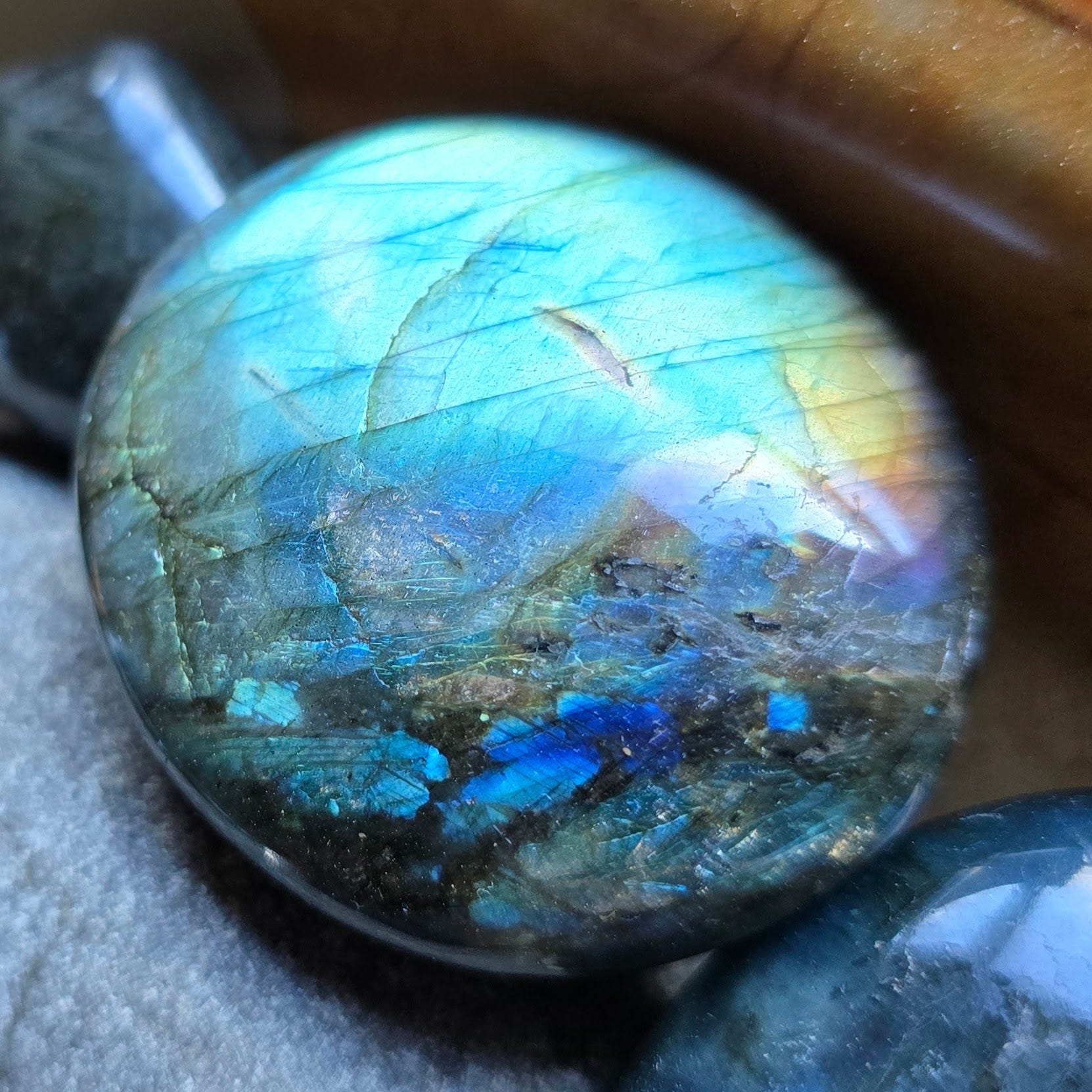
With Google Gemini’s help I pulled together a geological description:
Labradorite is a plagioclase (i.e. banded) form of crystalline feldspar and an intrusive igneous rock—igneous meaning volcanic and intrusive meaning it formed in magma that cooled inside the Earth rather than on the surface. Labradorite’s “diaphaneity” property is classified as translucent to transparent, whereas for granite, it’s—not surprisingly—opaque.
Besides diaphaneity, “Schiller,” the German word and geological term for shimmer, is another key to Labradorite’s beauty. According to the Wikipedia gods, schiller is “the metallic iridescence originating from below the surface of a stone that occurs when light is reflected between layers of minerals.”
The combined effect of the diaphaneity, plagioclase banding, and schiller is so distinctive that it has its own word: “labradorescence.”
I’ve long been a sucker for schiller. Dichroic glass and mother of pearl feature significantly in my earrings tray. My favorite painting medium is iridescent watercolor. During summers on a lake in Maine when I was still in single digits, I’d stare at the peacock sheen on the water by the gas docks, and I still go into an altered state when low sun spreads diamonds over open water. Labradorite had me at hello.
The flare or flash in a piece of Labradorite can look like the aurora borealis, spring rain, a field of grass, a waterfall, trees in a forest, firelight, sunset, rubies in gossamer, a turquoise and cobalt sea, a tidepool, or a storm. It all depends on the specimen and how it’s lit. Once the light source turns away, the flash disappears into a gray humdrum like a superhero hiding in old sweats and a hoodie.
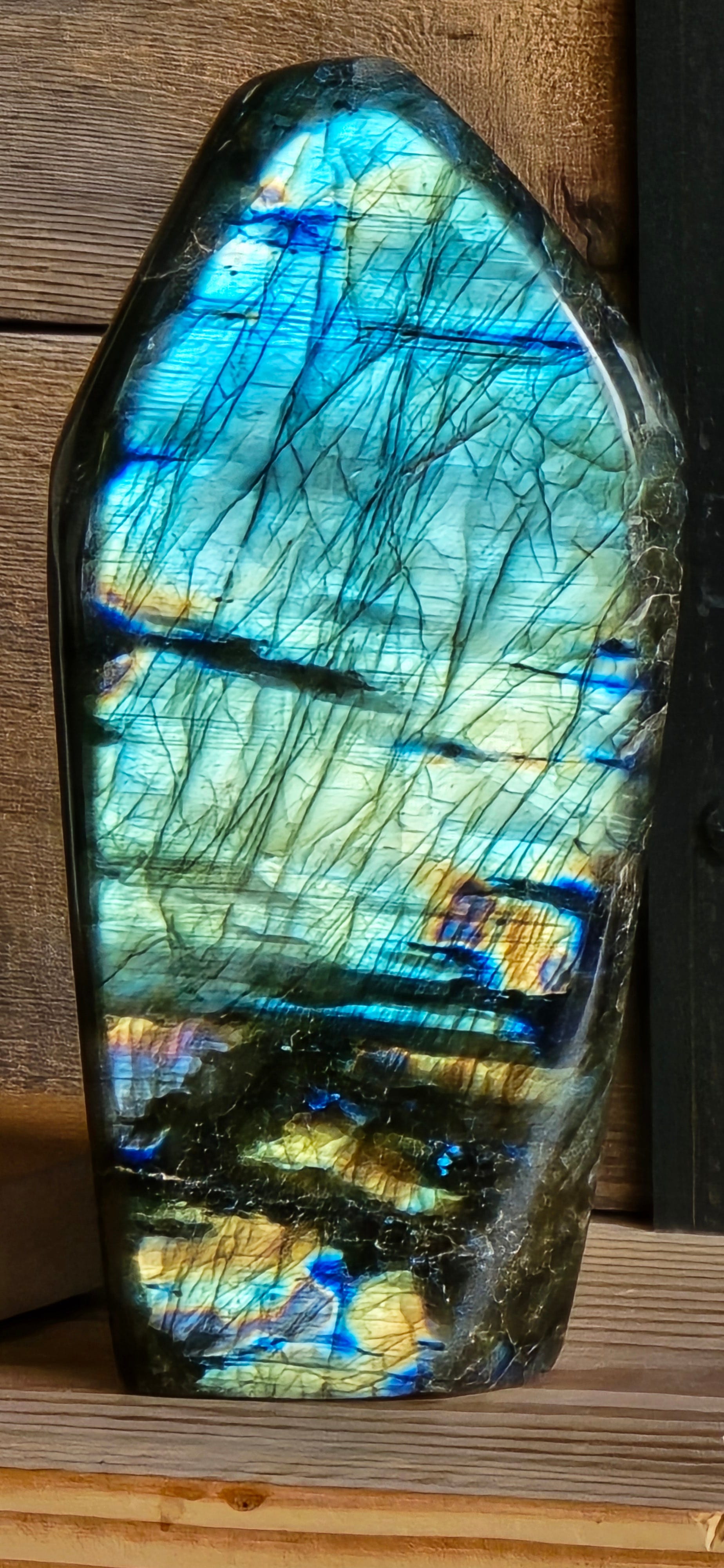
My most radiant specimen—the tall one in the photo below (the photo doesn’t nearly do it justice)—usually stands alone near a wall of windows where it catches a full day’s light. From sunrise to dark, it beams an iridescent land and waterscape so vivid that it still startles me sometimes. Even after dusk when the room has little light left, this piece shines like a beacon you’d swear was lit from within. The effect is, in a word, stunning.
It’s also powerful. It can center space like a hearth and elevate space like a rocket. Just picturing it when I’m far from home helps me collect myself, soothe my homesickness or loneliness, and rise to another level.
In person, it helps me ground and reconnects me with awe. It’s as if it were an emissary from the mineral kingdom, here to snap me awake and remind me that I’m made to light up too.
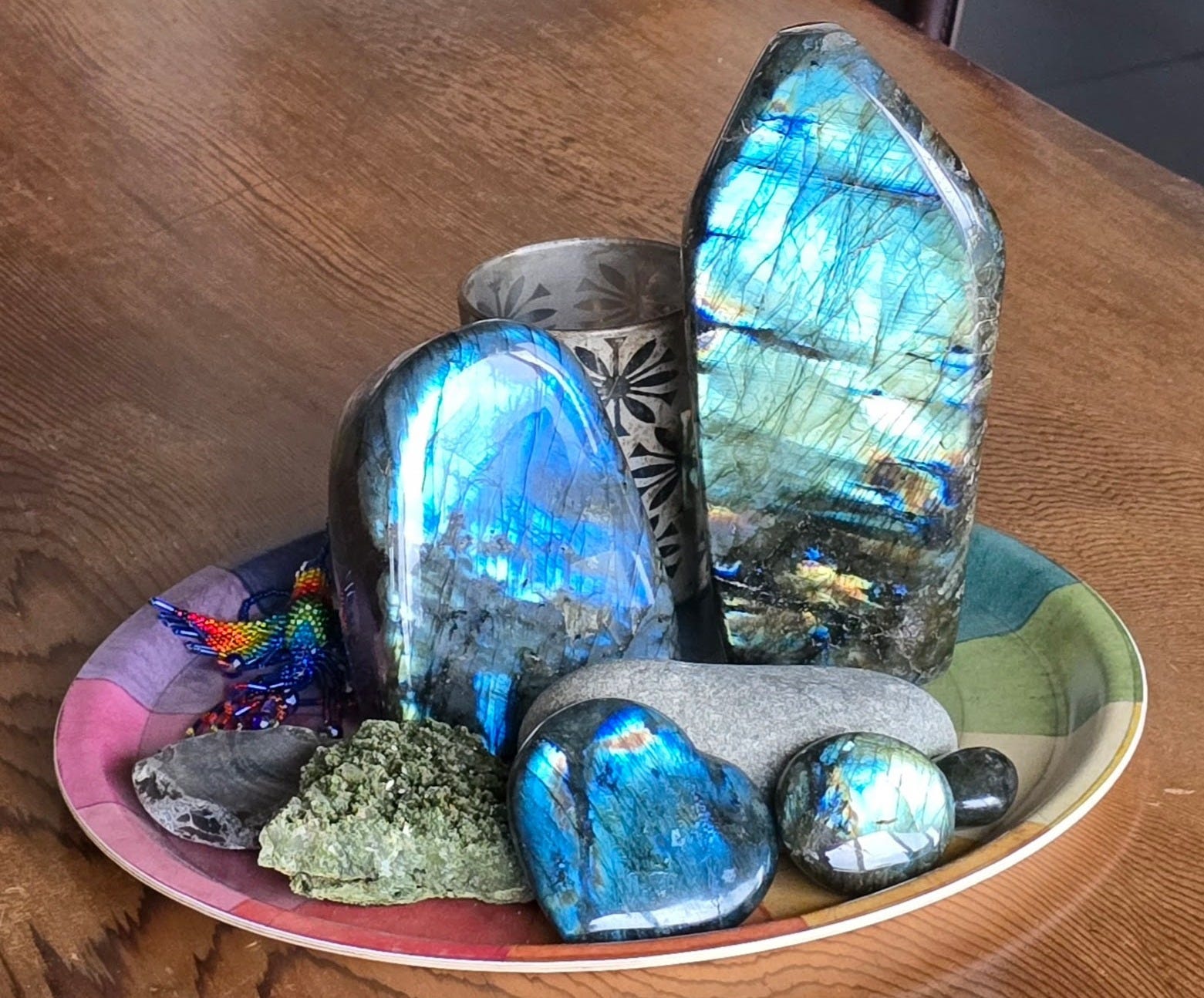
Many people work with crystals and minerals in a deliberate, even systematic way. I don’t. I find most descriptions of minerals’ reputed healing and mystical properties so generic, all-encompassing, or repetitive as to be useless—supposedly healing everything from gout to doubt.
Instead, I look for pieces that draw my attention—specimens with gorgeous color, sparkle, or a certain something. I trust that spending time with them is beneficial, whether that’s for a few seconds in a dusty Utah rock shop or a few decades in my home. What I bring to the encounter also matters; presence and appreciation are evolutionary forces.
The result is my somewhat motley collection of crystals and rocks, still sizable despite the many I gave away or released back into the wild last year. Most of what’s left is in storage, waiting for my next home or the next round of letting go.
I tried keeping my largest piece of labradorite in storage too, for safekeeping, but it was like losing a tooth or an important memory—its absence nagged at me. Now it’s back out, joined by others, and set up where it can shine.
As a talisman, it connects me with a sense of home that’s more about consciousness than geography. Its beautiful bold-in-the-light, shy-in the shadow flare helps me remember that all it takes to recover my sense of awe is a different angle, a little light, and a closer look.
.
Your writing rocks! ;) I love this. It has me reflecting on the characteristics of the rocks I've collected and displayed around my home(s) since forever.
Oh dear, I now add labradorite to my bucket(well okay, boxes) list. BEAUTIFUL and profound, like the earth and people and forests if we only catch them at the right moment, in the right light. And to continue to remember and feel into the experience, like you do!